
Jefferson County Busted Booking Records
What goes into a Jefferson County booking record? It's the paperwork generated when a person enters custody at the Jefferson County Correctional Facility. Sheriff's correctional staff create the file after an arrest. Expect identity details, the arresting agency, the arrest date and time, charges as booked, bond information, a warrant reference, and the offense degree. Want a current booking photograph? The Sheriff's current inmate search is the public path that links one to a live entry. Everything after booking plays out in court, where the case file carries the rest of the story.
Important: A Jefferson County booking entry documents an arrest and custody event within the county jail system.
Jefferson County Booking Fields and Limits
How much detail can a public booking lookup give you? Not everything. The county's current-inmates PDF offers the fullest inventory of text fields. The photo-bearing web search shows current names with linked images. A blank field online doesn't mean the information is missing. The live record, or a well-framed public-records request, is what truly controls what's available for a given entry.
| Field | What it means in the county record |
|---|---|
| Name and age | Identity details used to distinguish a matching entry. |
| Arrest date and time | The time recorded in the booking source, which can differ from an officer’s first contact. |
| Arresting agency | The agency that brought the person into the county system, such as Beaumont PD, Port Arthur PD, Nederland PD, JCSO, or another agency. |
| Charge and degree | An charge and classification entered at booking, not a disposition. |
| Bond and warrant number | Fields that can be revised, blank, paid, or subject to a court order. |
| Booking photo | A linked image asset in the current Sheriff search, not in either reviewed PDF. |
Some fields just aren't universal across county results. A court date may appear, or it may not. The same goes for a release date, home address, physical description, case number, or older booking photo. The current-inmates PDF itself warns that its information can change. Keep that in mind when you weigh an online entry against a later court docket.
The current JCSO Inmate Search is the county's official photo-bearing path. The image below shows the source interface itself, not a gallery or reproduced record.
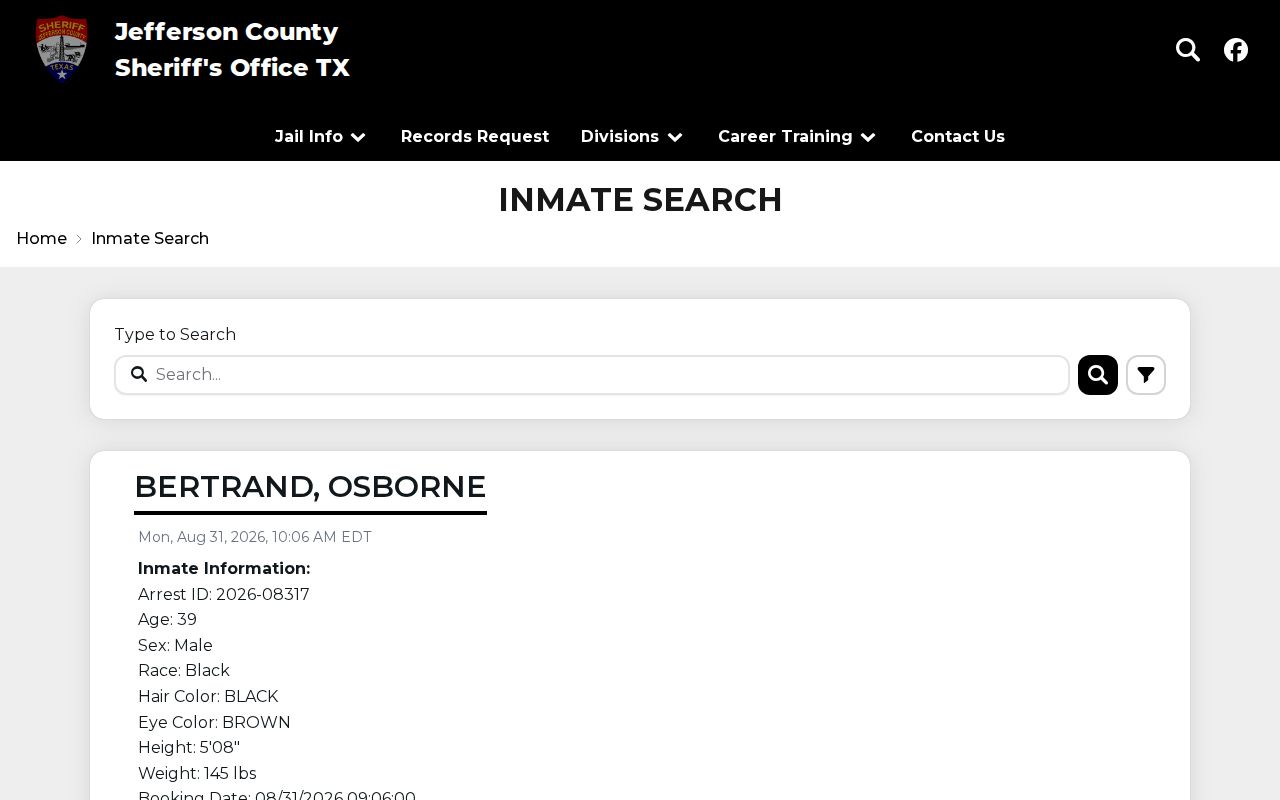
This search answers one question well. Who is in custody right now? Match the name against non-photo details before drawing any conclusion, since live results shift. Note the date you accessed it. Entries can change at any time.
Request a Jefferson County Booking Photo
Missing a current entry doesn't end the hunt. Three official routes stand ready. They are the Jefferson County Sheriff's records-request page, the county public-information page, and the JCSO Records Request Form. The form asks for a detailed, specific request. It also asks you to acknowledge that costs may apply. No single fee or fixed turnaround time is promised for every booking record or photo.
- Give the person’s full legal name and an approximate arrest or booking date.
- Add the arresting agency or booking number if known, and say whether the request is for a current entry, historical booking record, incident record, or photo.
- Ask for the booking record and booking photograph, if public and maintained, rather than broadly requesting every file.
- Send the request to records@jeffersoncountytx.gov, or call 409-835-8696 or 409-835-8419 for routing and cost questions.
- If material is withheld, ask the custodian to identify the legal basis. A partial response or no responsive record does not establish that no arrest occurred.
Need a human on the phone? The records unit sits inside the Jefferson County Sheriff's Office at 1001 Pearl Street, Suite 103, Beaumont, TX 77701. Call the main line at 409-835-8411. Book-in questions go to 409-726-2540, and release questions to 409-726-2541. These numbers help route a custody question to the right desk, though none of them guarantees a photo or record released over the phone.
Texas Rules for Jefferson County Busted Records
Texas law sets the frame for all of this. The Texas Public Information Act governs records held by Texas governmental bodies, and Section 552.108(c) keeps basic facts about an arrested person, an arrest, or a crime public even when other law-enforcement material stays withheld. It doesn't unlock everything, though. Juvenile files, victim details, medical records, sealed material, and active investigative content can all stay closed or redacted, and the record custodian applies those rules.
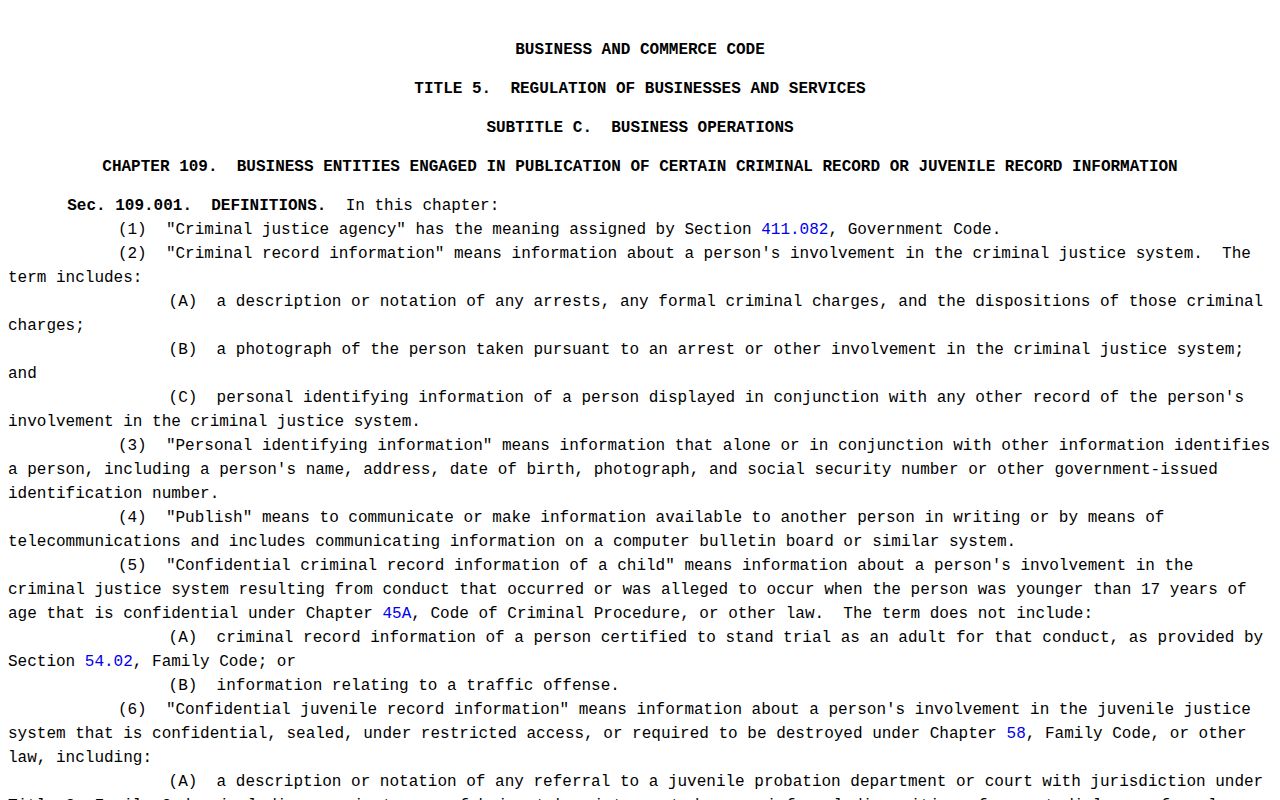
Texas Business & Commerce Code Chapter 109 covers businesses that publish criminal-record information drawn from public sources. The statute imposes accuracy, correction, and removal-fee restrictions in the situations it describes. It is not a blanket right to erase an accurate booking record. A practical route: start with the originating agency or a publisher's free correction process, give enough detail to identify the record, and consult the current statute or a lawyer for anything individual. Never pay a third party promising removal.
Expunction and nondisclosure are two different legal creatures. Under Texas Code of Criminal Procedure Chapter 55A, a court can order an expunction directing agencies to return or destroy records, while a nondisclosure order generally just limits public access. The Texas State Law Library's overview explains both in plain language. Juvenile, sealed, protected-victim, medical, and active-investigation information may also be withheld.
The Chapter 109 text is the right official source for any correction or publication question. The page below captures that official law source and shows the line between a statutory correction route and an unsupported commercial promise.
Already got a source page taken down or changed? Google's Refresh Outdated Content tool can update the search display. It won't touch the underlying Sheriff or court record. And it's no substitute for an expunction.
Finding Jefferson County Mugshots and Recent Arrests
Let custody status pick your starting point. For anyone currently held, the official JCSO Inmate Search is the county's confirmed public photo path. Search the name. Open the matching result. Then compare the agency, date, charge, and other identifiers it shows. A photo alone won't settle a similar name or a stale record.
- Check the current Sheriff search when the person may still be held. It displays current names and linked booking-photo assets.
- Open CURRENTARRESTS.PDF for the past-24-hour intake window. It is text-only and can show a recent booking that does not remain on the roster.
- Use CURRENTINMATES.PDF for the broader current-custody snapshot, including the arresting-agency field.
- Use the Sheriff’s request process if the person has been released, transferred, or is absent from live county sources.
- Check the correct court record for a later disposition. A roster name is not a court outcome.
An older Jefferson County inmate search is also worth a try. The county posts new booking details within an hour of processing. Treat that as a target, not a promise. A heavy intake day can slow things down. So can a transfer, a manual review, or a site outage. If a name fails to appear, wait a bit. Then search again.
Jefferson County Busted Roster Search
The current JCSO search tool answers one narrow question. Is this person in county custody right now? Type a name into the search box. Matching entries come back with linked booking photos. It is not an archive. Nothing older survives there once a person is released or moved. The results show photos but few other details. So weigh any name match against what you know, such as age, before trusting it.
| Official source | Custody scope | Photo status |
|---|---|---|
| JCSO Inmate Search | Current county custody | Linked booking-photo assets |
| Legacy county search | Current-inmate lookup fallback | Not confirmed as the present photo path |
| CURRENTINMATES.PDF | Broader current and multi-day custody snapshot | No photos |
Photos live only in the current search. The PDF feeds never display images. Neither document carries booking photos. For older ones, a public-information request to the JCSO may be the only route. The law allows redaction or outright withholding. Timing matters too. A person can appear in a daily arrest feed yet no longer sit on the live roster. Someone on the roster may also have been booked days before the latest feed window.
The Jefferson County Sheriff's Office app landing page points to Google Play and the Apple App Store. It serves as an official channel for alerts and jail information. The page itself does not confirm a searchable booking-photo feature. Check the store listing for the latest features. When you need a photo, lean on the web inmate search.
Jefferson County Recent Booking Feeds
The two county PDFs serve different purposes. CURRENTARRESTS.PDF is labeled "Jail Arrests For Past 24 Hours," built on a 6:00 AM to 6:00 AM window in the example reviewed. Each line can carry name, age, race, sex, arrest date and time, charge, arresting agency, case or warrant number, and degree. No photos, though. It is a fresh intake snapshot, not a full count of county arrests or current holds.
For wider coverage, turn to CURRENTINMATES.PDF. The reviewed file ran about 100 pages and listed name, age, race and gender, arrest date and time, agency, charge, bond amount, warrant number, and degree. Like the arrests list, it has no images, and its own footer warns that the data can change. Simple rule: use the arrests PDF for the newest day's bookings and the inmates PDF for everyone in custody across multiple dates.
The past-24-hour PDF appears in the image below. Since it is text only, treat it as a way to confirm timing and arresting agency rather than as a photo roster.

Q: Can a person appear in the arrest feed but not on the current roster? A: Yes. Release, transfer, or a custody change can remove them after the daily item was generated. The reverse happens too. A current inmate may have been booked before the latest 24-hour window opened.
Jefferson County Busted Custody Channels
One name can travel through several systems. The county roster and its PDFs cover Jefferson County alone. They track current custody and fresh intake. They skip citation-only matters. They skip people already released. Anyone moved to state or federal custody is left out too. Each source answers a specific question. Match the source to what you actually want to know.
| Status | Official starting point | What the result does not establish |
|---|---|---|
| New county booking | Past-24-hour arrests PDF | That the person remains in custody or has a posted photo |
| Current county custody | JCSO Inmate Search and current-inmates PDF | A final court disposition |
| Released or transferred | JCSO records request and relevant court clerk | Current jail custody |
| Texas state custody or supervision | TDCJ Offender Search | A current Jefferson County booking or a public photo |
| Federal or immigration custody | BOP locator or ICE locator | A county booking record or photo |
TDCJ handles the state slice: prison custody and state supervision, not new county bookings. Its public inquiry rules are blunt. Inmate photographs are not released to the public. BOP and ICE run locators for their own populations, not county mugshot collections. The U.S. Marshals Service offers a FOIA route instead of a public roster. Keep one thing in mind. A dead end in one system says nothing about another.
Jefferson County Court Disposition Path
A booking is just the first step. The court trail that follows tells the real story. For district-court criminal cases, search the Jefferson County District Clerk criminal index by filing year, indictment number, or defendant name. Then open the case file itself. The docket and disposition entries inside hold far more than a name search alone.
Class A and B misdemeanors take a county path instead. The County Clerk's own form lists the limits plainly. Coverage runs from January 1, 1982 to the present. The $10 fee is nonrefundable. Statewide records, Justice of the Peace cases, tickets, and matters outside listed District Attorney coverage are all excluded. City ordinance, traffic, and Class C cases usually land in municipal court. Whichever court holds the case holds its final outcome.
- Booking
- Jail intake after an arrest or custody transfer.
- Bond
- A court-set condition that can change and is not a finding of guilt.
- Disposition
- The court’s later result, such as dismissal, acquittal, plea, or conviction.
- Expunction
- A court process with statutory eligibility rules that can direct record handling.
Jefferson County Busted Record Retention
How long a Jefferson County busted record stays online is not the same question as how long the government keeps it. Texas State Library Local Schedule PS sets minimum retention rules for local records. Nothing in that schedule promises a booking image stays on a public website. Logs and dockets, arrest reports, photos in investigation files, and jail incarceration records each fall under their own series. Classification, record type, and any legal hold all shape the answer.
One example is PS4200-10. It covers jail prisoner material like commitment, transport, release, booking-in, and booking-out forms. The minimum is release or transfer plus two years. PS4125-02 sets its own minimums for arrest reports and fingerprints. PS4125-05 governs offense-investigation records that expressly include mug shots. These are baselines only. They do not promise a past booking stays in the current Sheriff search. They cannot override a seal, an expunction, a confidentiality rule, or an agency correction.
Older Jefferson County material lives elsewhere. The Sam Houston Center’s Jefferson County holdings and the Texas convict-ledger archive are strong starting points for historical research, not modern booking-photo feeds. Ask the county custodian or archive whether a specific record was accessioned. A web entry that vanishes does not mean the record became archival.
Retention also says nothing about public access. A public-information request may return only basic details or a redacted record when another law applies. A current roster can shift mid-correction, while a court order is pending, or after a transfer. Meanwhile, an old copy can sit on an unofficial page long after the official entry disappears. The fix is simple. Verify with the office that holds the record and ask which part, if any, stays public.
Juvenile names deserve special care. An age shown on a roster does not settle whether a record is confidential, certified as adult, or protected another way. The same caution covers victims with protections, medical details, active-investigation material, sealing, and expunction. Jefferson County residents seeking a correction should find the source custodian first. Then present the court order or other paperwork through the official process.
A practical historical request starts with three things: the approximate date, the arresting agency, and the record type. A booking photo request is not the same as one for an incident report, a current custody result, or a court file. The Sheriff’s Records unit is the right first custodian for county intake material. A city police department may hold its own incident records. Keep the requests separate. Never treat a live roster as a full archive. Save the agency response and its date, since a record can be corrected, redacted, or transferred after you view it.
Jefferson County Busted Mugshots by City
Beaumont, Port Arthur, and Nederland each run their own police department. None offers a stable official city photo roster, though. Once a person enters the Jefferson County facility, county systems become the practical route for booking information. For an incident report or a city records request, the city department is still the better source.
- Beaumont Busted Mugshots: BPD records and the county’s current-custody sources serve different records.
- Port Arthur Busted Mugshots: PAPD report requests are distinct from JCSO booking-photo requests.
- Nederland Busted Mugshots: NPD open-records routes do not establish present county custody.
Verified media context starts with official records. The Mugshots in the News page points to local reporting and shows how to trace a story back to its underlying booking or court record.